Alice Run
Jog in place.
Move through a story.
A Joy-Con turns indoor jogging into a journey through an endless grassland.
I wanted a run that sets its own pace and tells a story.
After years of playing fitness games, I kept running into menus, interruptions, and challenges that depended on game skill. I wanted a space I could make my own, with a story to fill the time.
Alice Run connects slow indoor jogging to a moving landscape. Strap a Joy-Con to your thigh, connect it to the browser, and each detected step advances the scene.
I played five fitness games for over 300 hours before building my own.
I wanted my exercise recorded and rewarded, so I finished most of the Switch fitness games I could buy. Each did something well, and each got in the way of the workout somewhere.

Fitness Boxing
165 hours
Well made, with good visuals and music. Squats were hard to detect, so most players switch on automatic judging, and some achievements make you box with characters you do not like.

Ring Fit Adventure
95 hours
The only one with resistance training. Menus, drinks and skill choices between levels break the workout into pieces, the player can quietly slack, and progress depends on game skill.

Fitness Circuit
40 hours
Mostly lower-body work, which kept my heart rate up every session. Some moves ask for opposite arm and leg directions at once, and the difficulty of a day’s plan swings from exhausting to effortless.

Let’s Get Fit
10 hours
Feedback on the whole movement, which is rare. The difficulty curve is so steep that a session felt like nothing or wore me out, and it crashed often.

Family Trainer
4 hours
Its running and jumping kept my heart rate high. Slow jogging stops after ten minutes, and a good session should last at least forty.
A training program should set the pace and leave nothing to game skill.
Those games gave me four rules. None of them met all four, so I built one around a single exercise: slow jogging on the spot.
Look and sound modern
It does not need to be beautiful, and it can do without music. If it has music, the choice should not be embarrassing.
Keep the heart rate up
The session should hold a high heart rate for its whole length, since that is what burns energy and builds fitness.
Make the game as hard as the exercise
Difficulty should come from the workout, and never from game controls.
Let the program lead
The program decides the movement, the rhythm and the length. Doing it earns a reward, and falling short gets feedback and shows in the score.
In middle school I lost my belly in one winter break by jogging in place in front of the television for an hour a day. It never left me out of breath, which is why I kept at it. Slow jogging, as it is now called, works best at three steps a second, 180 a minute, and can be done indoors while watching something.
Running on the spot covers no distance, so Alice Run reports steps per minute. In one session my Fitbit counted just over 6,000 steps and the Joy-Con on my thigh counted just over 9,000. Every step on screen has to match a step in the room, or the runner feels cheated, so phones and watches were dropped as sensors.
Falling behind darkens the scene and never ends the run.
When adding local two-player mode, I rethought what failing should mean. A dark scene already tells you that you've slowed down. A harsh failure screen only gives you a reason to give up, so I cut Game Over entirely.
Cadence indicator
A vertical meter marks your current cadence against the target cadence in the story. In local two-player mode, the slower runner sets the baseline pace.
Visual pace feedback
When your pace drops below the target, the screen darkens with a vignette and slight scanline jitter.
Recovery without a restart
Falling behind darkens the scene, and the run continues with no failure screen. Speeding up clears it again.
A story keeps a forty-minute run company.
Alice runs across an endless grassland while a voice tells her to flee, with no idea who she is or what is chasing her. Code can be written well or badly, but a script that will not come cannot be forced. I wrote an opening, asked language models for a dozen ways it could continue, cut and rewrote the parts that fit, and fed the result back in.
The monologues are voiced in Japanese, which suits the quiet, empty scenes. I generated them with ElevenLabs, which guesses the language from the text and sometimes read a line in the wrong language. Writing those lines in kana fixed it, and commas gave long sentences back their rhythm.
Only one of the voices I tried sounded natural in Japanese, so the first version has a single narrator.
Two runners can play a chase that nobody loses.
A second Joy-Con adds a second runner. One plays Alice and the other plays the unknown fear behind her. The faster the second runner goes, the darker the scene gets, and their pace is the slowest Alice may run.
Losing all health was meant to end the game. A darkening screen already puts enough pressure on a runner, and a failure screen after it would only give them a reason to stop, so I removed Game Over from the whole game.
I planned online play with uneven teams and cut it back to two people chasing each other in the endless mode, which keeps the company and costs far less to build.
After a two-player run, the summary shows both runners’ steps and pace, and draws each runner’s pace as its own line.
I designed and built the whole game alone, and ran the playtests myself and with friends.
Playtests on friends’ computers added settings and found a leak.
Feedback from friends led to graphics settings, adjustable step detection, and an optional pixel-rendering mode. My longer test runs also exposed a cache leak.
Graphics settings for smaller computers.
I added grass-density and render-resolution controls after friends tested the game on netbooks. These settings reduce the graphics workload on smaller computers.
Adjustable step sensitivity.
Faster runners reported sluggish step detection. The Sensitivity setting lets runners adjust the trigger threshold to match their movement.
Long-session testing.
A personal run became badly choppy after more than 0 minutes. A leaking trigonometric cache was the culprit; removing it let me complete the story-mode test.
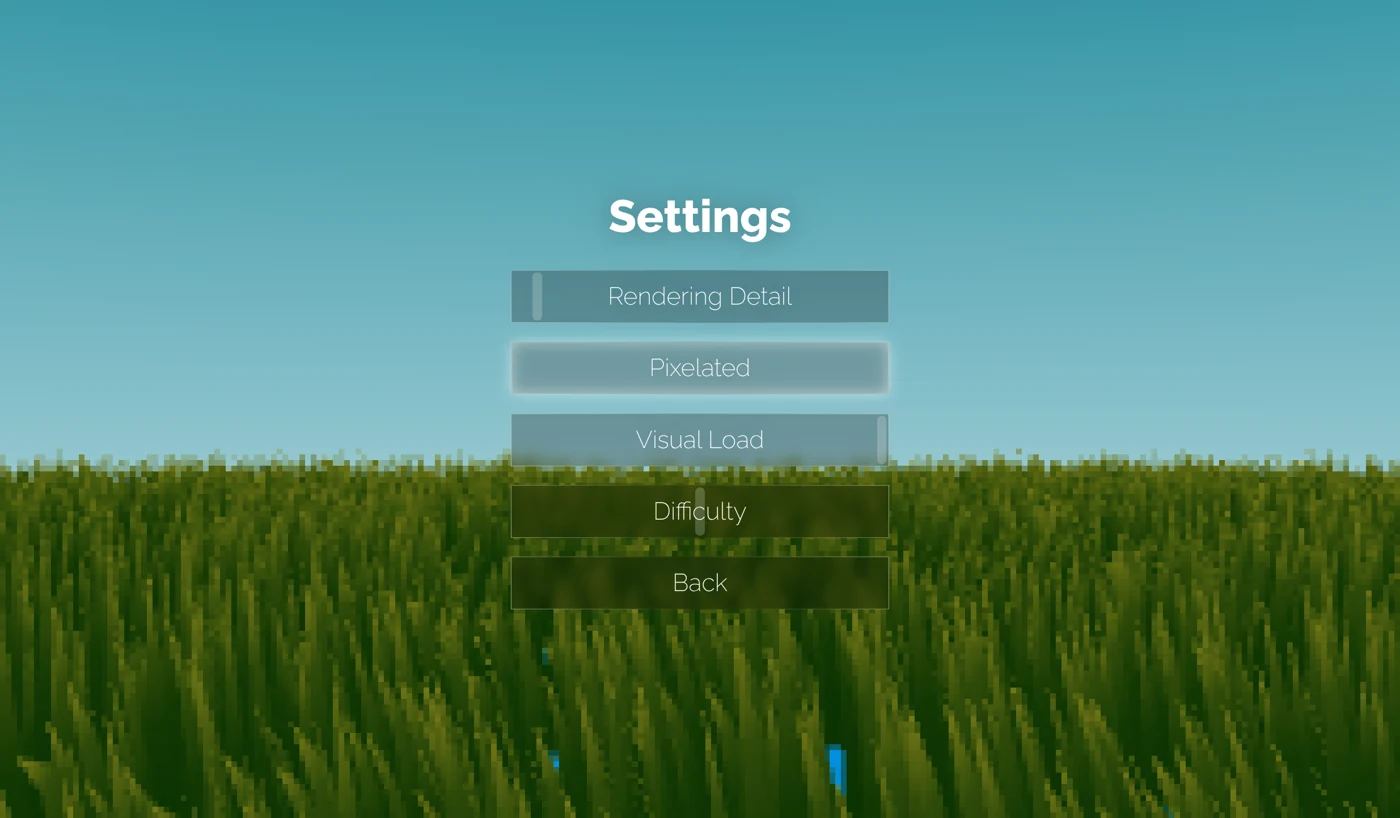
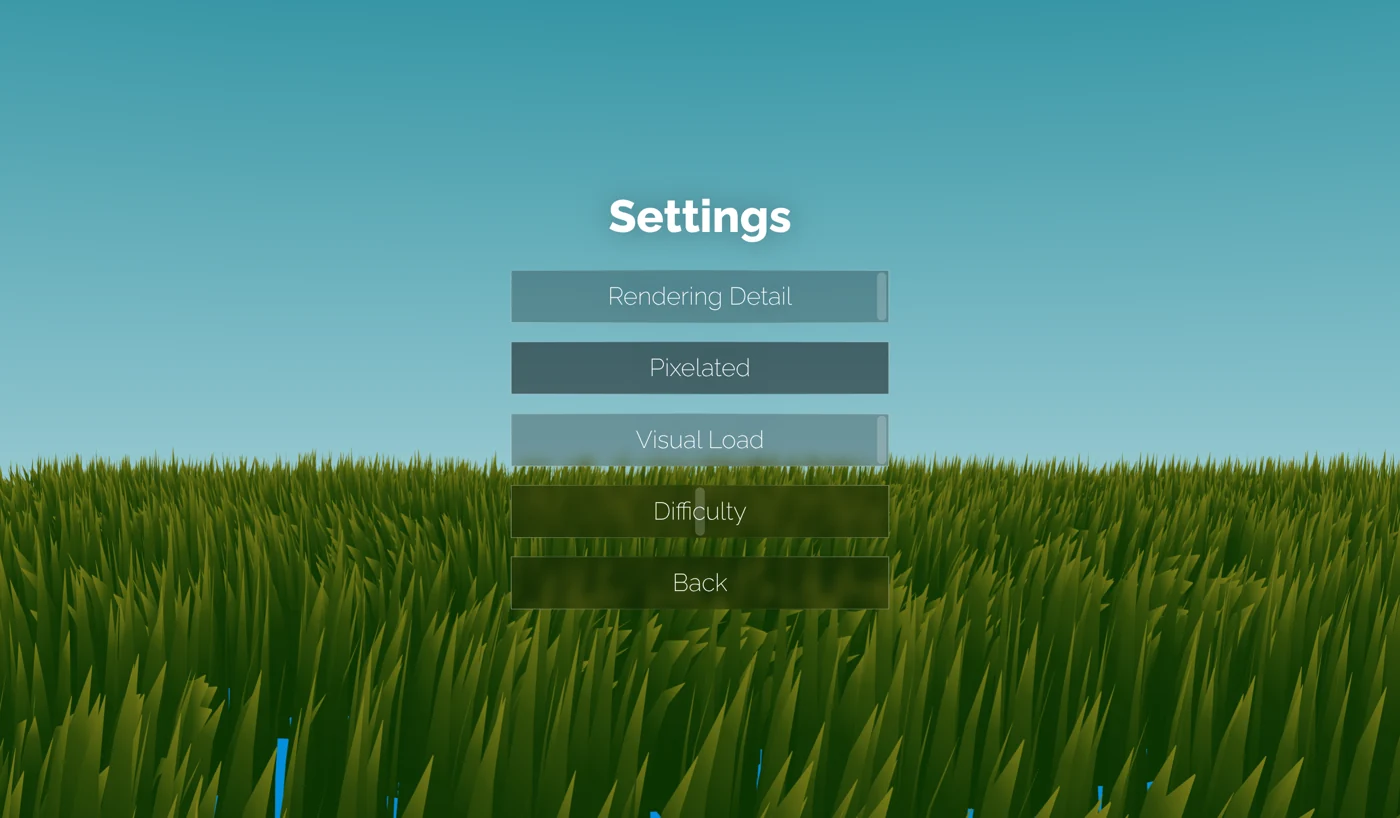
One friend asked for a retro look, so pixel mode was added.
Switching pixel mode on plays a bright chime along with the visual change.
Play Alice Run.
Open the game or browse the source for its input handling, graphics, and story playback.
Next project · Personal Blog
A personal blog,
built for reading.
Editorial structure, motion, and the details of publishing on the web.
Read the case